

11:00:13 pm 01/06/2026
Viewed: 2644
The Moment of Transition
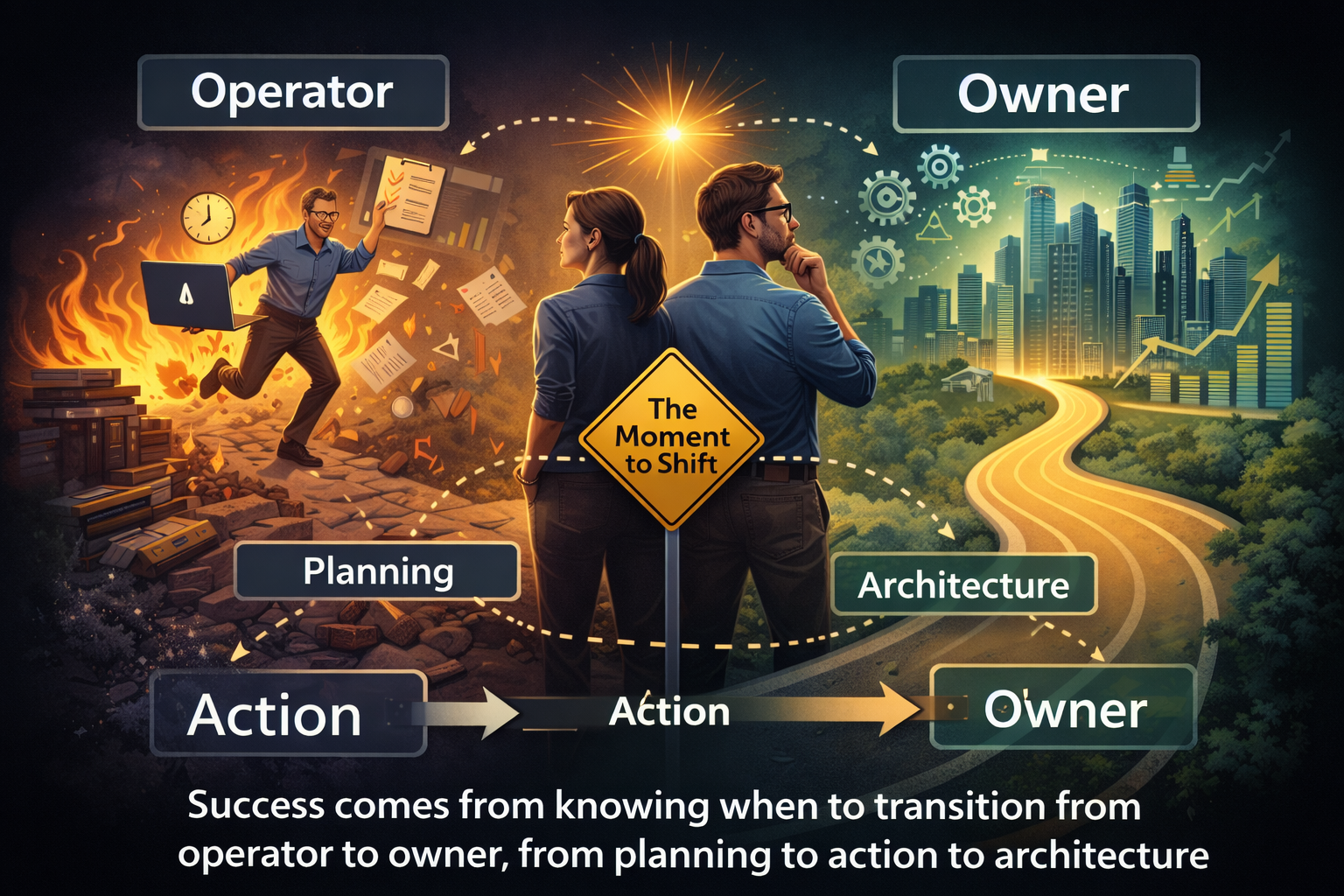
The earlier lesson warned against planning so much that action never begins. The next lesson warns against acting so much that growth never compounds. Together, they describe the same critical skill: knowing when to change roles.
As Tony Robbins teaches, winners take action before conditions are perfect—but he also draws a clear line between being an operator and becoming an owner. These are not contradictory ideas. They are sequential.
In the beginning, life demands that you act.
When nothing exists yet—no system, no revenue, no proof—planning is cheap and execution is rare. At this stage, excessive thinking is paralysis disguised as intelligence. Action is what converts intention into reality. You must operate. You must be close to the work. You must learn through friction. There is no architecture to design because there is nothing standing yet.
This is where imperfect action is essential.
But success introduces a new danger.
Once action starts working, effort begins to feel virtuous. You solve problems faster than others. You become reliable. Indispensable. The system bends around your competence. And quietly, without realizing it, yesterday’s strength becomes today’s ceiling.
At this stage, continuing to “just work harder” is no longer courage—it is avoidance of the next evolution.
The trap shifts from overplanning to overoperating.
What once required action now requires architecture.
The operator’s mindset says: I’ll fix it.
The owner’s mindset asks: Why does this keep needing to be fixed?
The operator measures value by effort.
The owner measures value by leverage.
This is the moment most people miss—not because it is invisible, but because it is uncomfortable. Designing systems means stepping back. Letting others perform imperfectly. Accepting short-term inefficiency in exchange for long-term freedom. It requires surrendering the identity of being the hero in favor of being the architect.
The two lessons now converge:
Early success requires acting before certainty.
Lasting success requires designing before exhaustion.
Use planning to aim.
Use action to learn.
Use architecture to scale.
Those who fail plan forever and never move.
Those who stagnate move forever and never build.
The rare few recognize the pivot point—when effort has extracted all the value it can, and only structure can take things further. That recognition, more than talent or intelligence, is what separates temporary wins from enduring success.
This is the discipline of transition—and it is one of the defining skills of a well-lived life.
0
1
Comments
Log in to add a comment.