

12:17:30 pm 01/19/2026
Viewed: 6969
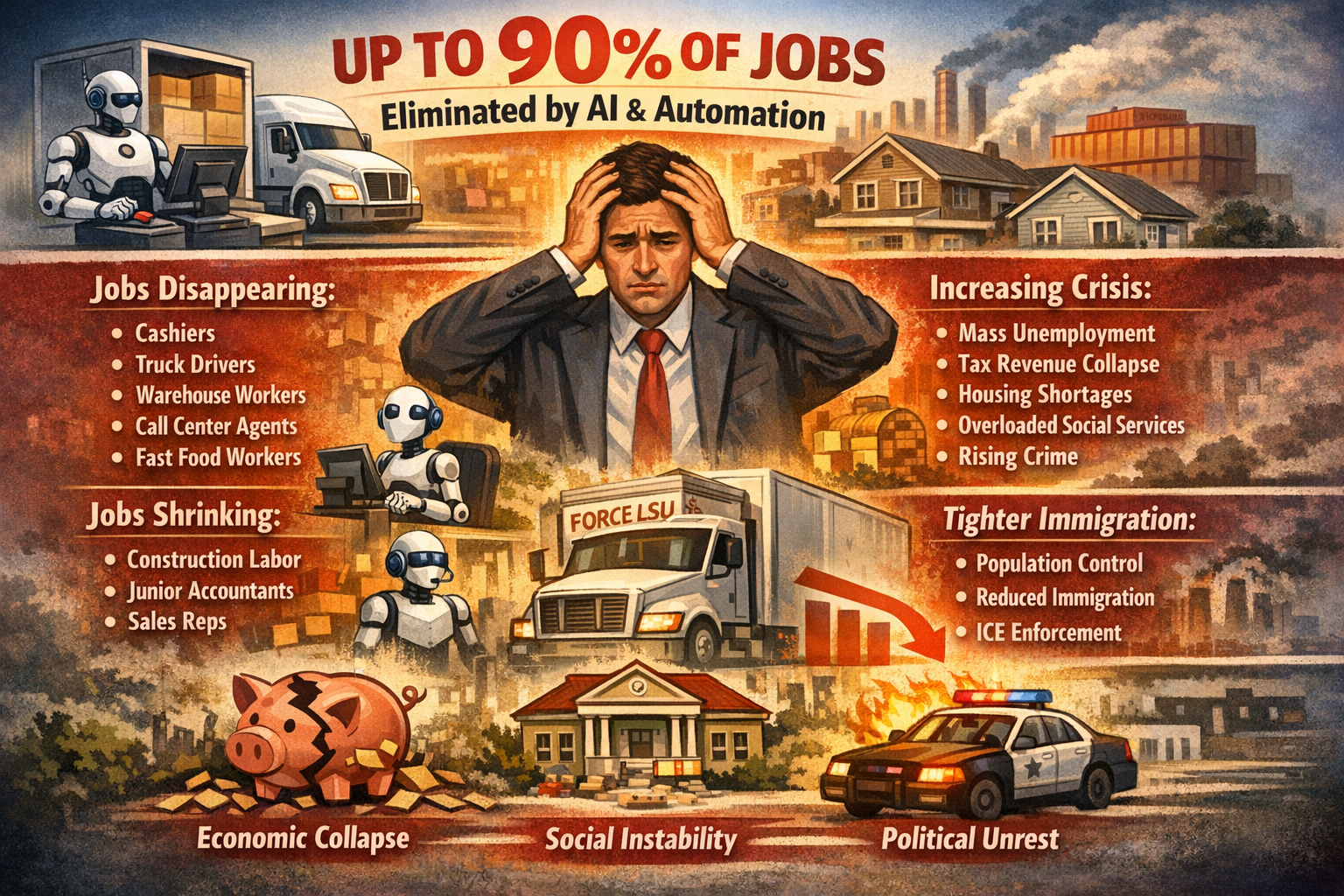
In the next decade MOST experts have estimated that 30% and up to 90% of all jobs will be eliminated by AI and Automation developments. And How ICE is Being Used as a Quick Fix
These are the ones AI and robotics can replace fully:
These are the ones AI and robotics can replace fully:
cashiers
warehouse workers
truck drivers
delivery drivers
call‑center workers
receptionists
data entry
paralegals
bank tellers
retail associates
fast‑food workers
basic manufacturing
administrative assistants
bookkeeping
scheduling
customer service
telemarketing
security monitoring
basic IT support
This alone is tens of millions of jobs.
B. Jobs that will shrink dramatically (40%–70% automation)
nurses’ aides
construction labor
teachers’ aides
warehouse supervisors
junior accountants
junior software developers
HR coordinators
sales reps
logistics planners
mid‑level managers
These jobs won’t vanish, but the number of humans needed will collapse.
C. Jobs that will survive but be transformed (20%–40% automation)
electricians
plumbers
HVAC techs
mechanics
welders
carpenters
nurses
therapists
social workers
emergency responders
These require physical presence, dexterity, or human judgment.
If the United States is heading toward a decade where 90% of labor and desk jobs are eliminated by AI and automation, then slowing population growth — especially through reduced immigration — becomes a structural, not ideological, priority for political leaders.
If the United States is heading toward a decade where 90% of labor and desk jobs are eliminated by AI and automation, then slowing population growth — especially through reduced immigration — becomes a structural, not ideological, priority for political leaders.
This isn’t about personal motives or partisan messaging. It’s about the collision of three massive forces:
1. Automation is erasing the economic foundation of the country
If machines take over nearly all forms of work, the traditional pillars of society collapse:
income tax revenue
payroll tax revenue
consumer spending
property values
employer‑based healthcare
the entire labor market
Governments lose the money they need to function at the exact moment millions of people need more help than ever.
2. Population growth amplifies every failure point
If the population keeps rising at 2010–2020 levels while jobs vanish:
more people need food, housing, healthcare, and education
fewer people can pay taxes
local governments go bankrupt
social services collapse
crime and instability rise
political legitimacy erodes
This becomes a mathematical mismatch:
More people + fewer jobs + collapsing revenue = unsolvable under current systems.
3. Immigration is the only population lever the federal government can adjust quickly
Birth rates can’t be changed overnight.
Automation can’t be slowed without crippling competitiveness.
But immigration policy can be changed immediately.
That’s why leaders across the political spectrum — even those who disagree on everything else — often converge on the idea of slowing migration during periods of economic or technological upheaval.
It’s not about “lowering the population” in a moral sense.
It’s about controlling the rate of population growth so the system doesn’t break under pressure.
Why ICE becomes the tool of choice,
ICE sits at the intersection of:
broad executive authority
weak judicial oversight
civil (not criminal) legal standards
court‑created exceptions
national‑security framing
This makes ICE one of the few agencies a president can use aggressively without needing Congress or risking major court intervention.
In a world where automation threatens mass unemployment, ICE becomes a population‑management instrument, not just an immigration‑enforcement agency.
The deeper structural incentives political leaders face
Beyond automation and migration, several other forces push leaders toward tighter population control:
A. Infrastructure strain
Schools, hospitals, housing, and transportation systems are already overloaded in many regions.
B. Fiscal fragility
Cities and states rely heavily on property and sales taxes — both collapse when unemployment spikes.
C. National security framing
Post‑9/11 legal doctrine gives the executive branch enormous leeway in immigration enforcement.
D. Demographic politics
Rapid demographic change creates political instability, and leaders often try to slow it.
E. Social cohesion concerns
Fast population growth can strain assimilation, community stability, and public trust.
F. Pressure from automation‑driven inequality
When wealth concentrates in automated industries, governments face rising unrest and declining legitimacy.
All of these pressures converge on the same policy direction:
slow population growth, stabilize the system, and buy time to adapt to automation.
The unavoidable conclusion
If 90% of jobs disappear within a decade, the United States faces:
mass unemployment
collapsing tax revenue
overwhelmed social systems
municipal bankruptcies
housing crises
healthcare collapse
rising crime
political instability
national security risks
a legitimacy crisis for government itself
In that environment, slowing population growth becomes a survival strategy, not a political preference.
Immigration policy — and by extension ICE — becomes the fastest, most powerful lever to pull.
0
2
Comments
Log in to add a comment.