

03:32:45 pm 01/19/2026
Viewed: 8676
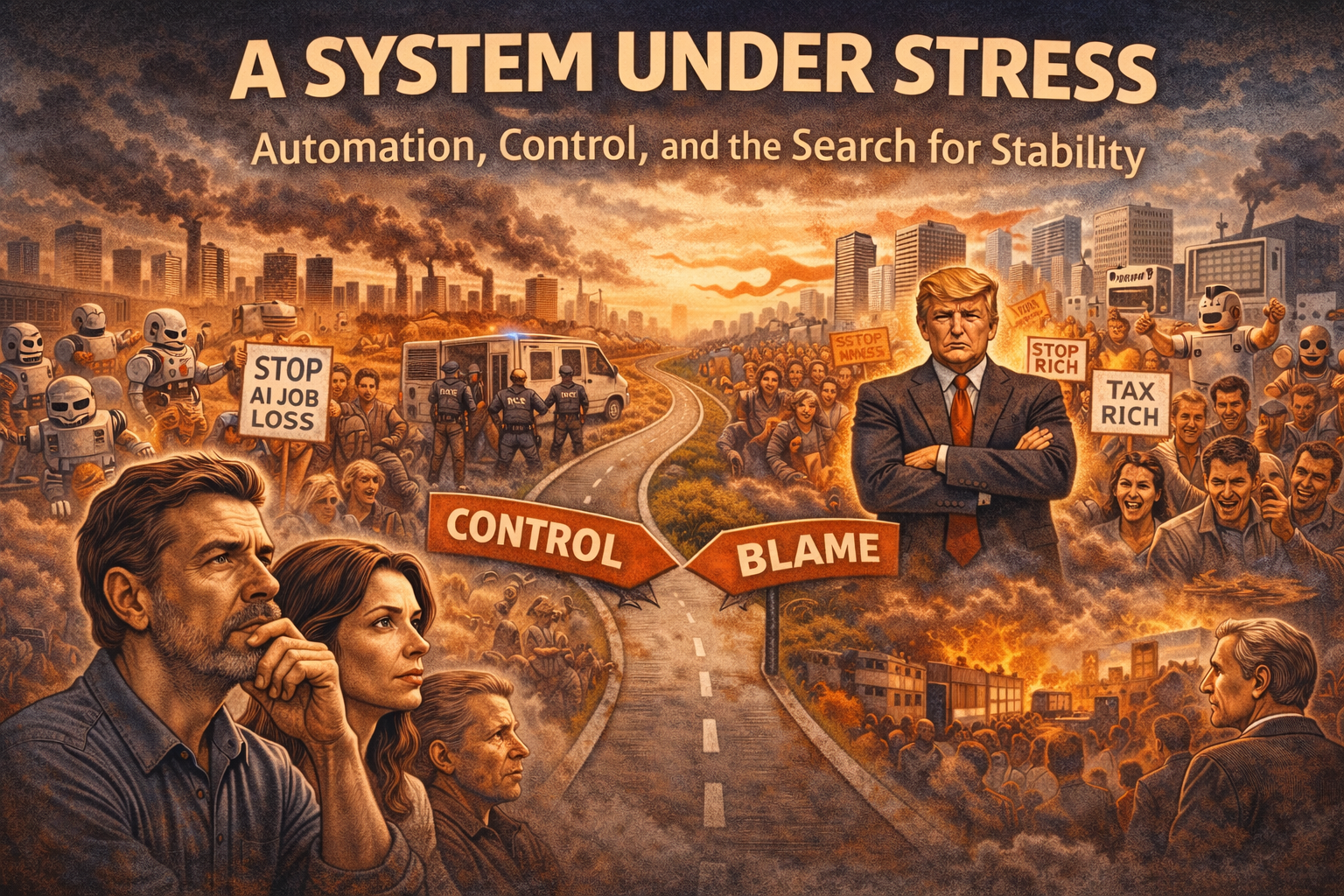
A System Under Stress: Automation, Control, and the Search for Stability
For a long time, what’s been happening in the United States has felt chaotic, disconnected, and irrational. Policies feel harsher. Rights feel less stable. Explanations don’t seem to match outcomes. Public anger keeps rising, yet the underlying problems never seem to be addressed.
At first glance, it looks like political dysfunction. Or ideology run amok. Or one man doing extreme things.
But when you step back and start looking at this as a systems problem, a different picture comes into focus—one that is less emotional, less conspiratorial, and far more unsettling.
What we are witnessing looks less like chaos and more like a system under pressure using the wrong tools to survive a transition it didn’t prepare for.
The Pressure Nobody Wants to Name
The starting point is automation.
AI, robotics, and large-scale automation are not future threats. They are present-day forces already reshaping labor, quietly but relentlessly. Entire categories of work—routine cognitive jobs, administrative roles, logistics, retail, transportation—are being reduced, consolidated, or eliminated faster than new roles can realistically replace them.
This matters not just for workers, but for the structure of society itself.
Employment underpins:
tax revenue
consumer spending
housing stability
employer-based healthcare
local government budgets
social cohesion
When work disappears at scale, the system doesn’t just lose jobs—it loses its economic foundation.
That creates a dangerous mismatch:
more people relying on systems,
fewer people paying into them,
and no fast way to rebuild the base.
Why Population Pressure Becomes a Central Issue
Once job creation falls behind population growth, every other problem gets amplified.
Housing shortages worsen.
Social services stretch thinner.
Municipal budgets strain.
Public frustration rises.
In that environment, slowing population growth becomes a structural response, not an ideological one. Birth rates can’t be adjusted quickly. Automation can’t be slowed without losing competitiveness. But immigration policy can be tightened almost immediately.
That’s why, historically and globally, governments under economic stress often turn to immigration controls—not because immigrants caused the problem, but because population size determines system load.
This is where enforcement enters the picture.
Why ICE Becomes the Tool of Choice
ICE sits in a unique legal and operational position. It operates under civil law, not criminal law. It has broad executive authority. It faces limited judicial oversight. It can act quickly and visibly.
That makes it one of the few tools a president can deploy forcefully without new legislation or long court battles.
But speed comes at a cost.
Enforcement is not a tool designed for managing long-term economic transitions. It is a tool designed for immediate compliance, not adaptation. Used briefly, it creates order. Used continuously, it creates fear, instability, and backlash.
From a systems standpoint, this is poor design.
Fear suppresses behavior temporarily, but it also:
increases anxiety,
fuels rumor and conspiracy,
hardens opposition,
erodes trust across entire communities.
Citizens feel unsafe.
Legal immigrants feel targeted.
Communities destabilize.
Anger spreads far beyond the intended population.
The system may gain short-term control, but it sacrifices long-term legitimacy.
The Deeper Question: Why This Way?
At this point, it becomes reasonable to ask:
If enforcement causes this much damage, why lean on it so heavily?
The answer isn’t simple—but it becomes clearer when you look at how systems behave under stress.
When a system hasn’t prepared for a major transition, it shifts into emergency mode. Emergency mode prioritizes:
speed over fairness,
control over comfort,
reaction over planning.
And emergency tools tend to be blunt.
This is where leadership matters—not in terms of morality, but function.
Trump as a Container for Pressure
This is where Donald Trump enters the picture—not as the sole cause of what’s happening, but as a perfect focal point for it.
Trump concentrates attention and emotion in a way few leaders ever have. Actions that would feel cold and procedural under another president feel personal, aggressive, and extreme when associated with him.
That matters because systems under stress benefit when public anger has a human target.
Trump absorbs outrage that might otherwise turn toward:
institutions,
economic structures,
automation,
wealth concentration,
long-term policy failures.
He becomes the face of enforcement, the symbol of instability, the object of blame.
Not because of a secret plan.
Not because he’s a puppet.
But because systems naturally allow disruptive figures to carry stress they cannot afford to absorb themselves.
Testing Limits Without Admitting Crisis
Large systems rarely know their limits in advance. They discover them by pushing.
How much pressure will people tolerate?
How visible can enforcement become before legitimacy cracks?
How fast does unrest spread?
Where does resistance harden?
A polarizing leader allows those questions to be answered without the institutions themselves becoming the enemy.
If pressure becomes too intense, the system has an escape valve:
remove the person,
denounce the behavior,
promise a return to normal.
The anger dissipates.
Daily routines resume.
The deeper machinery remains intact.
This pattern isn’t new. History is full of leaders who absorbed the backlash of transitions they didn’t create.
Why This Is So Wrong
People sense that something fundamental is being avoided.
They feel fear replacing explanation.
Enforcement replacing planning.
Control replacing adaptation.
That instinct is correct.
Using emergency tools for long-term change creates instability, not resilience. It fuels unrest instead of preventing it. It delays the real conversation about automation, work, and economic redesign.
From a technical standpoint, it’s like running a system permanently on fail-safes. Yes, collapse is delayed—but damage accumulates everywhere else.
What a Better System Would Do
A system designed for transition would look very different.
It would prioritize predictability over fear.
Transparency over spectacle.
Universal policies over targeted pressure.
Economic adaptation over social control.
It would prepare people for change instead of punishing them for it.
Most importantly, it would tell the truth about what’s happening—because no system can be debugged while lying about the error condition.
Why This Matters Going Forward
If everything is blamed on Trump, the deeper forces driving this moment never get addressed. And if they aren’t addressed, removing one man won’t restore stability.
The system will simply need another container for pressure.
Understanding this doesn’t excuse harm. It doesn’t minimize suffering. It doesn’t defend anyone.
It does something more useful.
It explains why things feel the way they do—and why repeating the same approach will only make the next phase worse.
The Real Choice Ahead
This moment isn’t about left versus right, or one leader versus another.
It’s about whether society continues managing a historic economic transition with emergency tools—or finally begins designing systems that can adapt without tearing themselves apart.
Control can buy time.
Adaptation builds stability.
And the longer adaptation is delayed, the more often the system will reach for scapegoats instead of solutions.
That’s the real risk hiding underneath all the noise.
0
4
Comments
Log in to add a comment.