

01:23:23 pm 01/20/2026
Viewed: 5864
There Are Rules — And a Philly Has Always Had Them
A Philly cheesesteak is not a “build-your-own gourmet sandwich.”
It never was.
It is a working-class South Philadelphia street food, born on flat-tops, eaten standing up, judged in one bite, and never explained to tourists. The moment you start slicing the meat, toasting the roll, or adding toppings, you are no longer talking about a Philly. You’ve crossed a bridge—into Jersey, New York, or some suburban mall food court. Whatever you’re holding might be a steak sandwich, but it is not a Philly.
That distinction matters, because a Philly cheesesteak and a steak sandwich are not the same thing. They come from different cultures, different histories, and different expectations. Outsiders get it wrong because they’re naming the wrong thing.
In South Philly, These Were Never Options
In the neighborhoods where the Philly was born, the rules weren’t written down because they didn’t need to be. Everyone knew them.
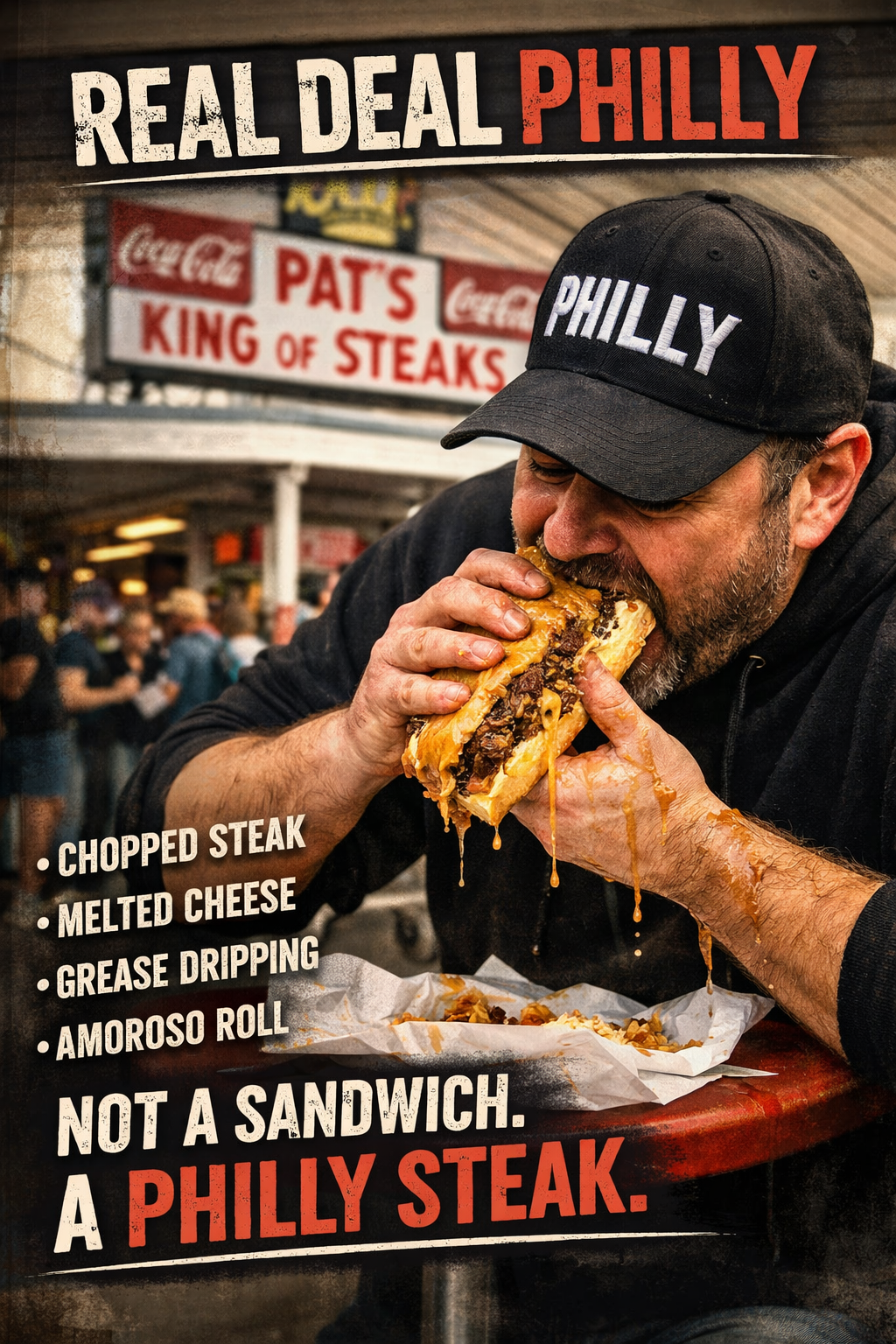
Chopped steak isn’t a preference — it’s the foundation.
Sliced steak doesn’t count. That’s for tourists.
The cheese melts into the meat.
That’s not a “style choice”; it’s the definition. If the cheese sits politely on top, you already failed.
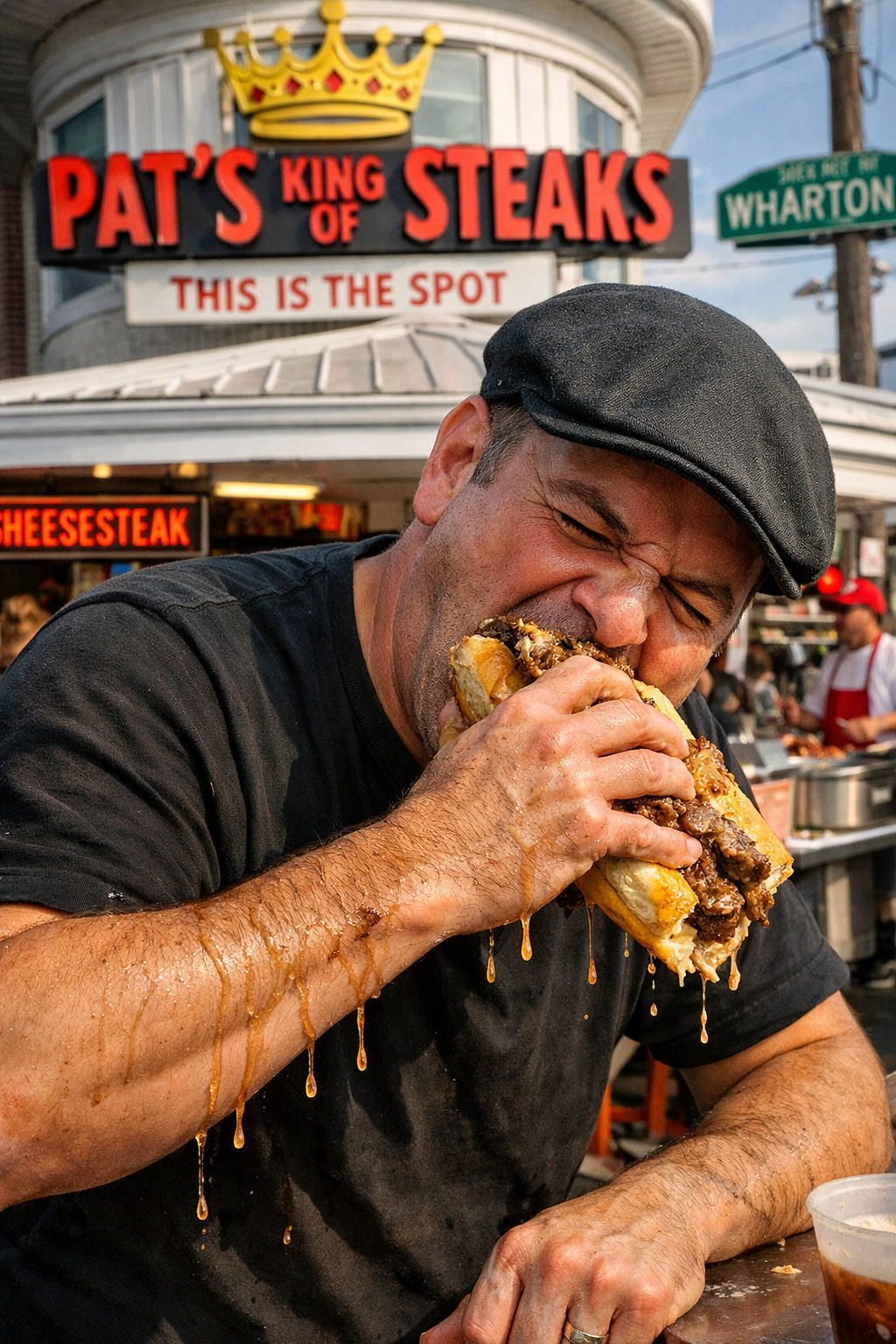
Grease running down your arm isn’t a flaw — it’s proof.
A dry Philly is a contradiction.
The roll is Amoroso-style, soft, never toasted.
This isn’t a suggestion. It’s the law.
Onions, steak, cheese. Nothing else.
That’s not minimalism. That’s identity.
Ketchup, peppers, mushrooms, lettuce, tomato?
Those aren’t variations. They’re disqualifications.
This is how the sandwich was born, how it was eaten, and how it was judged for decades. Anyone who grew up in the neighborhoods understands this instinctively. You don’t debate it—you recognize it.
“Philly-Style” Almost Always Means “Wrong”
I’ve ordered “Philly-style cheesesteaks” all over the country, and even up into Canada. They almost never get it right. What shows up is usually sliced steak, giant chunks of meat, toasted bread so dry it predates the city itself, and a pile of toppings meant to hide the fact that the fundamentals are missing.
Let’s be clear:
A Philly does not use sliced steak.
It does not come in slabs or cubes.
It does not get dressed like a salad.
It does not rely on provolone or American as the default.
It does not need peppers, lettuce, tomato, or—God help us—spaghetti sauce.
A real Philly uses sharp cheddar or Whiz—yes, Whiz is pushing it for some, but it’s still inside the tradition. What it never uses is a toasted, dried-out roll that forces you to drown the thing in ketchup just to survive the bite.
When you pick up a real Philly, it’s heavy. The grease runs down your arm. Your arteries clog. You contemplate your mortality. That’s the experience. That’s the point.
And above all else: it is not a sandwich.
It’s a Philly steak. Full stop.
The Origin Isn’t Up for Debate
The Philly cheesesteak originated in South Philadelphia in the early 1930s, credited to Pat Olivieri, a hot-dog vendor who began cooking chopped beef on a flat-top and serving it on a roll. That stand became Pat’s King of Steaks, widely recognized by food historians as the origin point of the cheesesteak tradition. This isn’t myth or marketing—it’s documented local history.
You don’t have to like Pat’s. You don’t have to eat there. But you don’t get to rewrite where the Philly came from.
If you want a steak sandwich, order one. Enjoy it. Customize it. Toast the roll. Add whatever you like.
But if you’re going to say “Philly,” understand that the word already means something. It always has.
And if you don’t follow the rules, that’s fine—just don’t call it a Philly.
0
0
3
Comments
Log in to add a comment.